Heraclitus by Martin Heidegger
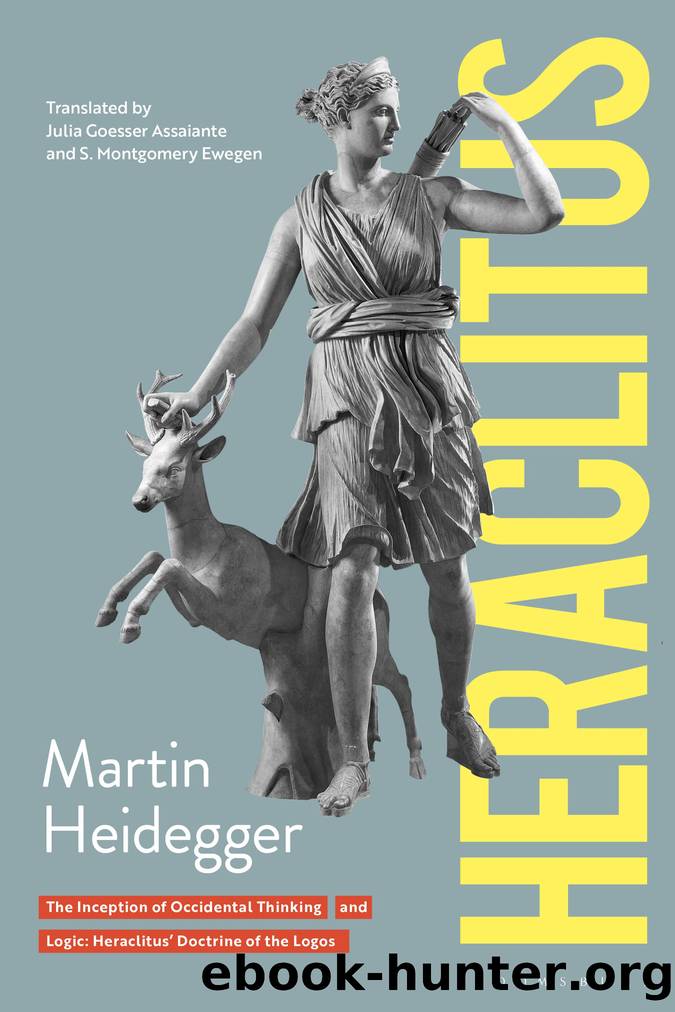
Author:Martin Heidegger [Ewegen, Julia Goesser Assaiante and S. Montgomery]
Language: eng
Format: epub
ISBN: 9781474249201
Publisher: Bloomsbury UK
Published: 2018-09-21T00:00:00+00:00
REVIEW
1) Logic as the reflection about reflection without an attachment to things. On the power of the self-reflection of subjectivity and pure thinking (Rilke, Hölderlin)
In this lecture on logic, we would like to set out to learn how to think. However, so that right at the beginning of our efforts a certain illumination already brightens this path, we must at least have provisional knowledge of what, through its traditional transmission (to which we are all knowingly or unknowingly subject), we understand as âlogic.â What is âlogicâ? What is it that is signified by this Greek name? What does it mean for the fate and course of thinking itself that, from long ago (although not from the inception), âlogicâ appears in Occidental thinking as the doctrine of correct thinking? Early on, âlogicâ is regarded as the á½Ïγανον, the tool and the equipment, as it were, with which thinking is handled. Since then, one finds it proper that thinking belongs under the province of âlogic,â as though this belonging together of âthinkingâ and âlogicâ had been eternally written in the stars.
Nevertheless, one is not entirely certain about the authoritative role accorded to âlogic.â Occasionally a suspicion regarding âlogicâ arises, even if it is only a suspicion regarding its usefulness (which, admittedly, remains only a superficial suspicion): for something can be without usefulness, thus being useless, and can nevertheless [208] still have beingâindeed, it can even be the case that the useless has infinitely more being than all that is useful combined. Behind the suspicion that logic is, in a practical sense, useless, owing to the fact that we always only learn correct thinking through contact with things and never through an âabstractâ logicâbehind this fear of the uselessness of logic there nevertheless remains a more serious concern.
The concern is this: that logic, as the doctrine of proper thinking, is itself a form of thinking. To âstudy logicâ therefore means to think about thinking. Hereby thinking bends back toward itself and becomes reflection. Since logic thinks about thinking and thinks about it in general, and since the thinking which is the object of this thought has no reference to an object determined in terms of its content, and thereby remains a pure thinking that dissolves into itself, logic as the thinking about pure thinking is not only reflection, but is rather the reflection about reflection, a reflection that whirls away into emptiness like a hollow vortex without an object or a connection to things. Logic: a thinking about thinking (i.e., reflection)âa detour into utter entanglement. If already within the context of dealing with things a thinking about them easily hampers action and decisiveness, what then would be the consequences of a thinking about thinking? Reflection, the bending-back toward oneself, is, as one says, âegocentric,â self-centered, self-absorbed, âindividualistic.â
But is this due to reflection? It is possible for a group of people to be focused upon itself as a group, as an association, as a coalitionâi.e., reflection. A people can be focused on itself and only itselfâi.
Download
This site does not store any files on its server. We only index and link to content provided by other sites. Please contact the content providers to delete copyright contents if any and email us, we'll remove relevant links or contents immediately.
The remains of the day by Kazuo Ishiguro(9085)
Tools of Titans by Timothy Ferriss(8492)
Giovanni's Room by James Baldwin(7436)
The Black Swan by Nassim Nicholas Taleb(7197)
Inner Engineering: A Yogi's Guide to Joy by Sadhguru(6836)
The Way of Zen by Alan W. Watts(6671)
The Power of Now: A Guide to Spiritual Enlightenment by Eckhart Tolle(5854)
Asking the Right Questions: A Guide to Critical Thinking by M. Neil Browne & Stuart M. Keeley(5832)
The Six Wives Of Henry VIII (WOMEN IN HISTORY) by Fraser Antonia(5558)
Astrophysics for People in a Hurry by Neil DeGrasse Tyson(5224)
Housekeeping by Marilynne Robinson(4504)
Double Down (Diary of a Wimpy Kid Book 11) by Jeff Kinney(4334)
12 Rules for Life by Jordan B. Peterson(4331)
Ikigai by Héctor García & Francesc Miralles(4311)
The Ethical Slut by Janet W. Hardy(4308)
Skin in the Game by Nassim Nicholas Taleb(4306)
The Art of Happiness by The Dalai Lama(4169)
Skin in the Game: Hidden Asymmetries in Daily Life by Nassim Nicholas Taleb(4051)
Walking by Henry David Thoreau(4000)
